EPJ Plus Highlight - Image processing brings new clarity to RTe3’s electronic structure
- Details
- Published on 05 March 2026
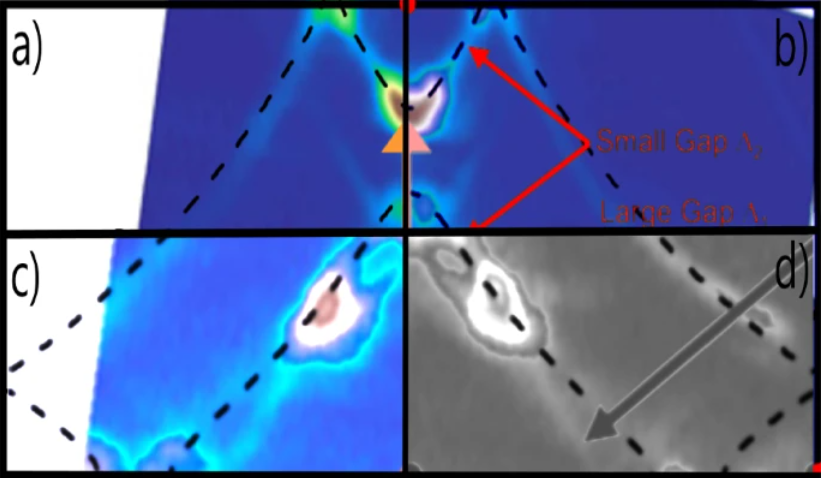
By applying image segmentation to ARPES data, researchers reconcile Fermi surface measurements with magnetic quantum oscillations and precisely determine the size of tiny electron pockets in rare-earth tritellurides.
Rare-earth tritellurides (RTe₃) are a class of two-dimensional quantum materials known for their diverse electronic properties. One of the most powerful tools for studying them is angle-resolved photoemission spectroscopy (ARPES), which probes the allowed energies and momenta of electrons in solids. Despite its strengths, conventional ARPES methods are not well suited to producing fully accurate two-dimensional momentum maps, limiting researchers’ view of the complex electronic landscape these materials host.
In new research published in EPJ Plus, a team led by Alexander Morocho and supervised by Prof. Pavel D. Grigoriev at the National University of Science and Technology (MISiS), Moscow, demonstrates how this limitation can be overcome through careful image processing of ARPES data combined with comparisons to magnetic quantum oscillations. Their results could help physicists better understand the origins of exotic quantum effects in RTe₃ compounds, possibly paving the way for new applications.
Below certain critical temperatures, RTe₃ can host superconductivity and charge density waves (CDWs), ordered states in which the electronic charge forms a standing-wave pattern. The CDW state is characterized by the opening of a CDW gap and the emergence of small electron pockets at the Fermi surface. Although ARPES is ideally suited to probing this state, technical limitations reduce its precision.
To address these challenges, Morocho’s team applied image segmentation to ARPES measurements, dividing images into regions with similar characteristics such as brightness and boundary continuity. Using this approach, they precisely calculated the size of the tiny electron pockets: closed momentum-space regions where electrons remain mobile even after a CDW forms.
Their results closely match magnetic quantum oscillation data, strengthening evidence for the persistence of these residual metallic states and highlighting the power of image-based ARPES analysis.
Morocho, A.A., Grigoriev, P.D. & Meng, JQ. Reconciliation of ARPES and magnetic quantum oscillation data via image processing in rare-earth tritellurides. Eur. Phys. J. Plus 141, 62 (2026). https://doi.org/10.1140/epjp/s13360-026-07308-1